Biacore SPR
Real-time binding on immobilized ligand yielding KD, association and dissociation rate constants, with stoichiometry and reference-channel subtraction.
Biacore · KD · kon · koffLabel-free binding and biophysical characterization led by Biacore SPR — affinity and kinetics (KD, kon, koff) for protein–small-molecule, protein–protein and antibody–antigen interactions, plus epitope mapping — supported by MST, DSF/TSA, ITC, CD and SEC-MALS for stability and oligomerization.
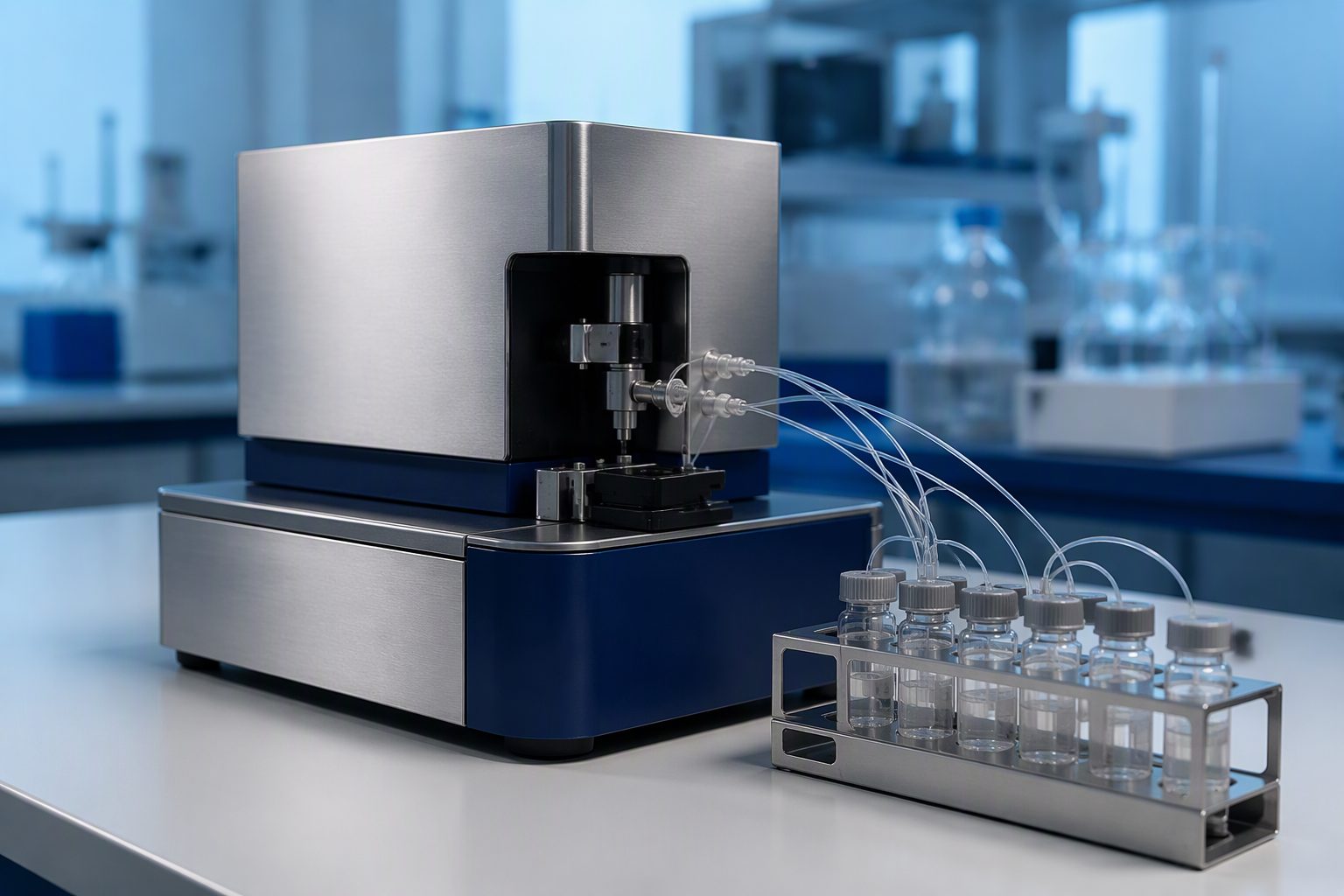
Biophysical methods measure binding directly, without a reporter or a substrate, which makes them the reference point when a biochemical and a cellular result disagree. Our lead platform is Biacore surface plasmon resonance: it gives real-time affinity and rate constants for protein–small-molecule, protein–protein and antibody–antigen interactions, and it supports epitope and decoy mapping.
The remaining platforms answer the other questions about the same interaction. MST works in solution with minimal material, DSF/TSA reports on ligand-induced thermal stabilization, ITC delivers a full thermodynamic profile, and CD and SEC-MALS characterize protein folding, stability and oligomerization state.
Formats and readouts covered by this service line.
The formats below are the working set for this service line. Where a programme needs a variation, the assay is adapted rather than forced into the closest existing format.
Real-time binding on immobilized ligand yielding KD, association and dissociation rate constants, with stoichiometry and reference-channel subtraction.
Biacore · KD · kon · koffBinding characterization for protein–small-molecule, protein–protein and antibody–antigen interactions across the SPR and solution platforms.
Protein–protein · Ab–AgCompetitive-binding and decoy-construct designs on SPR to map the binding epitope of an antibody or peptide.
Epitope · DecoySolution-phase affinity in free buffer or lysate, suited to targets that are difficult to immobilize.
MST · KDThermal-shift readouts for ligand-induced stabilization, run as a fast triage across compound or construct sets.
DSF · TSAITC for the enthalpy and entropy profile, plus CD and SEC-MALS for folding, stability and oligomerization state.
ITC · CD · SEC-MALSBiacore surface plasmon resonance is the lead instrument for binding kinetics and affinity, and it runs alongside MST, DSF/TSA, ITC, CD and SEC-MALS. The group shares protein handling and buffer preparation, so one set of samples can be characterized across several instruments without re-establishing conditions.
Raw instrument files are delivered alongside the processed tables, so any reported number can be traced back to the acquisition that produced it.
The practical decisions that shape how a study in this service line is set up, run and reported.
Send the target, the sample set and the decision the data needs to support. We will come back with a study plan covering the Biophysical Characterization (SPR / MST / DSF / ITC) format and the data package.