Metabolic Stability
Microsomal and hepatocyte incubations with time-point sampling to derive intrinsic clearance and predicted hepatic extraction.
CLint · HepatocytesIn vitro absorption, distribution, metabolism and excretion assays with quantitative LC-MS/MS detection. Metabolic stability, permeability, protein binding, cytochrome P450 inhibition and metabolite identification are delivered as quantified concentrations rather than relative signals.
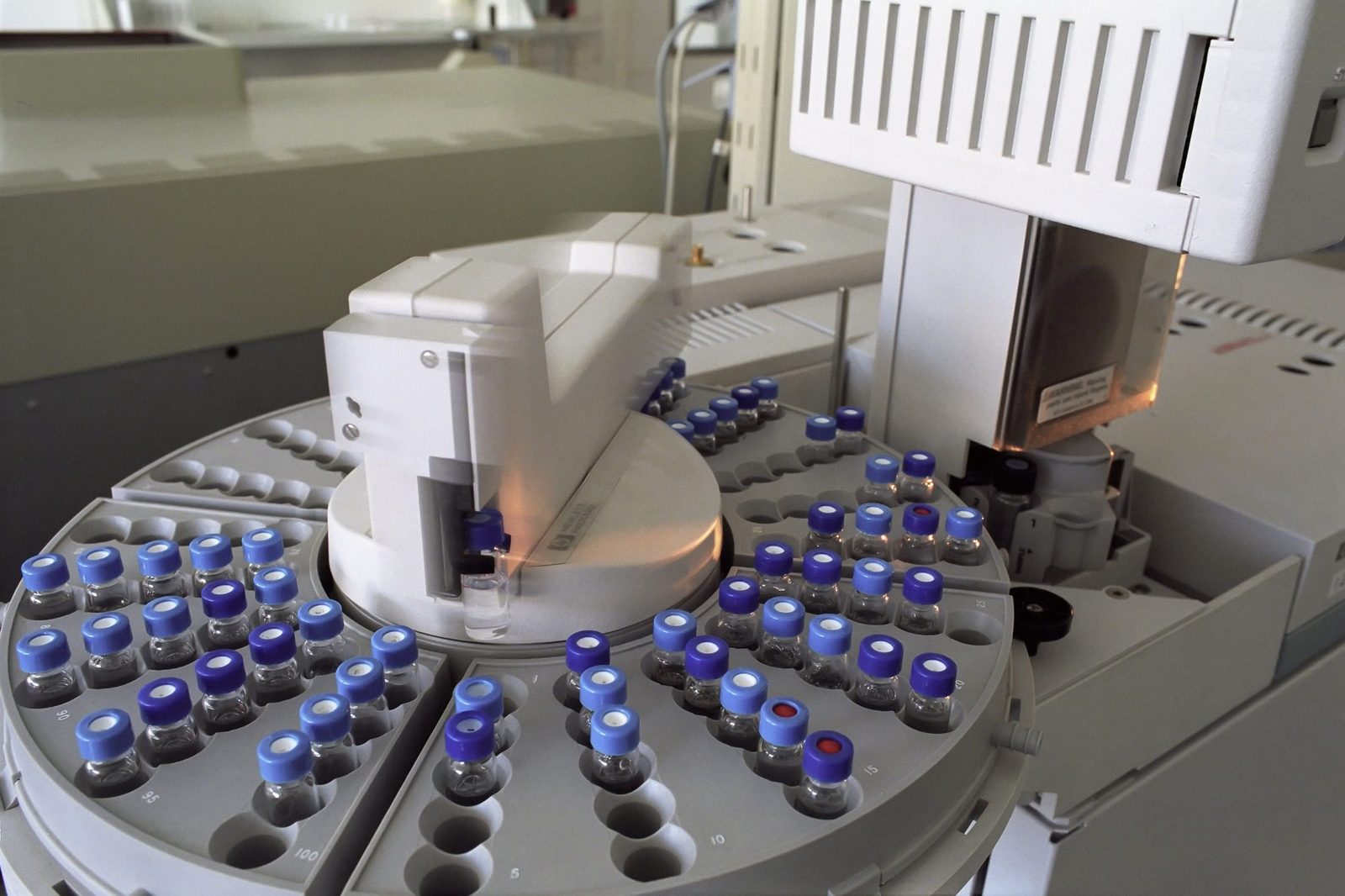
In vitro ADME work answers the early questions that decide whether a compound is worth progressing: how fast is it metabolised, does it cross a membrane, how much of it is free in plasma, and does it interfere with the enzymes that clear other drugs. Running these assays with mass-spectrometric detection means the answer is a concentration, which is comparable across compounds and across time points.
Bioanalytical support runs alongside the biology. Quantitation methods are developed and qualified for the matrices in play — buffer, plasma, microsomal or hepatocyte incubations, and cell-culture medium — so the same analytical pipeline serves both the in vitro screens and any subsequent sample set.
Formats and readouts covered by this service line.
The formats below are the working set for this service line. Where a programme needs a variation, the assay is adapted rather than forced into the closest existing format.
Microsomal and hepatocyte incubations with time-point sampling to derive intrinsic clearance and predicted hepatic extraction.
CLint · HepatocytesCaco-2 and MDCK monolayer assays reporting apparent permeability and efflux ratio, with transporter-substrate and inhibition designs where relevant.
Papp · Efflux ratioEquilibrium dialysis and ultrafiltration to determine free fraction across species, with recovery and non-specific-binding controls.
Free fraction · DialysisReversible and time-dependent inhibition across the major cytochrome P450 isoforms, plus induction markers measured at the transcript or activity level.
CYP · TDIHigh-resolution accurate-mass acquisition for metabolite profiling and structural assignment, including reactive-metabolite trapping when required.
HRAM · Met-IDMethod development and qualified quantitation for study samples, with calibration curves, quality controls and the acceptance criteria documented.
Calibration · QCQuantitation is carried out on liquid chromatography coupled to tandem mass spectrometry, with high-resolution accurate-mass detection available for structural work. Sample preparation, chromatography and detection are handled as one method so that biological results and analytical performance are reported together.
Raw instrument files are delivered alongside the processed tables, so any reported number can be traced back to the acquisition that produced it.
The practical decisions that shape how a study in this service line is set up, run and reported.
Send the target, the sample set and the decision the data needs to support. We will come back with a study plan covering the In Vitro ADME & LC-MS Bioanalysis format and the data package.