Enzyme activity & inhibition
Activity assays and dose-response inhibition profiling across a broad range of enzyme families, reporting IC₅₀ with residual activity.
IC₅₀ · InhibitionEnzyme activity and inhibition assays with full kinetic profiling — IC₅₀, Ki and Km — run on HTRF, AlphaLISA, fluorescence polarization and solid-phase (SPA) detection across a broad range of enzyme families for drug discovery research.
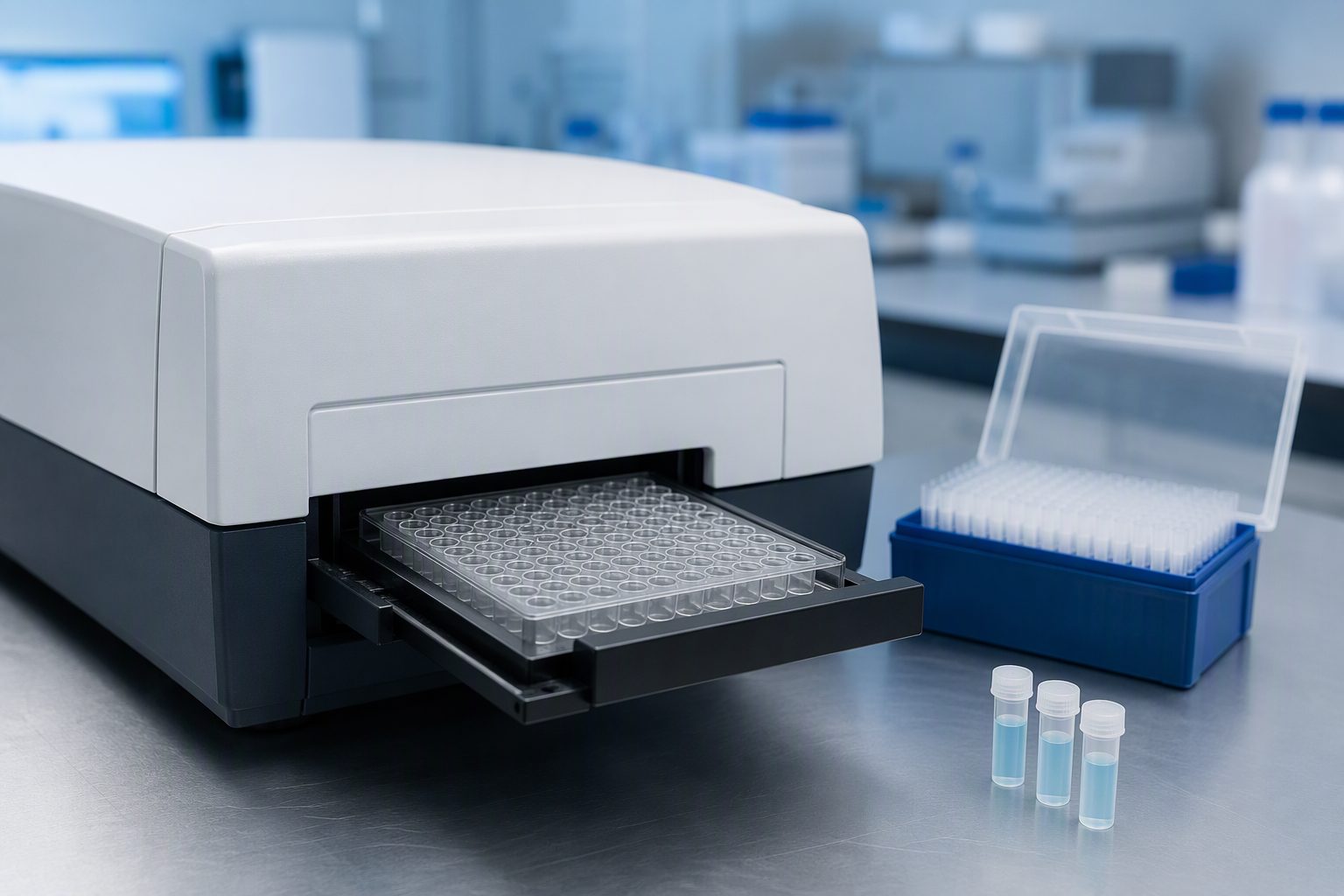
Enzyme and biochemical assays measure whether a compound engages its target before any cellular work begins. We build these assays around the target — choosing substrate, cofactor and detection chemistry so the readout sits inside a workable signal window — and support a broad range of enzyme families for drug discovery research.
The detection step is matched to the target rather than fixed to one technology. Homogeneous formats such as HTRF, AlphaLISA and fluorescence polarization let you read the reaction straight out of the incubation; solid-phase (SPA) formats are used where a wash step cleans the background; and conventional absorbance and luminescence remain available for the targets they suit.
Formats and readouts covered by this service line.
The formats below are the working set for this service line. Where a programme needs a variation, the assay is adapted rather than forced into the closest existing format.
Activity assays and dose-response inhibition profiling across a broad range of enzyme families, reporting IC₅₀ with residual activity.
IC₅₀ · InhibitionProgress-curve and endpoint formats for Km, Vmax, kcat and, for inhibitors, the kinetic constant Ki.
IC₅₀ · Ki · KmHomogeneous time-resolved fluorescence for low-background, no-wash inhibition and binding readouts in complex matrices.
HTRF · No-washAlpha-lateral fluorescent bead format for homogeneous detection of protein interactions and small-molecule binding.
AlphaLISA · Bead-basedLabeled-ligand displacement readouts for target engagement without a separation step.
FP · DisplacementWash-based formats for targets where a clean background is essential, including streptavidin- and capture-based designs.
SPA · Wash-basedReactions are read on multimode microplate readers across HTRF, AlphaLISA, fluorescence polarization, luminescence, absorbance and fluorescence intensity. Formats run from 96- to 384-well, including the low-volume designs used for compound-limited series.
Raw instrument files are delivered alongside the processed tables, so any reported number can be traced back to the acquisition that produced it.
The practical decisions that shape how a study in this service line is set up, run and reported.
Send the target, the sample set and the decision the data needs to support. We will come back with a study plan covering the Enzyme & Biochemical Assays format and the data package.